
5 Digital Strategies Driving Supply chain resiliency.
In today’s globalised and interconnected world, supply chain resiliency is one of the critical aspects of businesses’ operations. The COVID-19 pandemic has demonstrated the need for businesses to show Supply chain resiliency in the face of unexpected disruptions. In this blog, we will discuss five digitised strategies that are driving supply chain resiliency.
First a quick plug – Our sister companies Fresh Pharma whom are GDP Compliant Pharma couriers and ‘Fresh Fridge Hire‘ are our (compliant GDP) refrigerated vehicle hire.
 Introduction to Supply chain resiliency.
The COVID-19 pandemic has highlighted the importance of having a resilient supply chain. The pandemic disrupted global supply chains, causing shortages of essential products and increasing costs for businesses. To prevent such disruptions in the future, businesses must implement digitised strategies that increase the agility and resiliency of their supply chains.
The Importance of Supply Chain Resiliency
Supply chain resiliency is the ability of a supply chain to withstand and recover quickly from disruptions. Disruptions can be caused by various factors, such as natural disasters, geopolitical events, or unexpected demand changes. A resilient supply chain can mitigate the impact of these disruptions and ensure business continuity.
Natural Disasters and severe weather affecting supply chain resiliency
Natural disasters such as floods, hurricanes, and earthquakes can have a significant impact on the supply chain in the UK. For example, flooding in the UK has caused disruptions to transportation and logistics, resulting in delayed shipments and lost revenue for businesses.
To mitigate the impact of natural disasters on the supply chain, businesses can implement several strategies, such as identifying alternate transportation routes, diversifying suppliers, and investing in insurance policies that cover losses due to natural disasters.
Cybersecurity Threats
With the increasing reliance on technology in supply chain management, cybersecurity threats have become a major concern for businesses in the UK. Cyber attacks can result in data breaches, stolen intellectual property, and financial losses.
To mitigate the impact of cybersecurity threats, businesses can implement several strategies, such as investing in robust cybersecurity measures, conducting regular risk assessments, and providing cybersecurity training to employees.
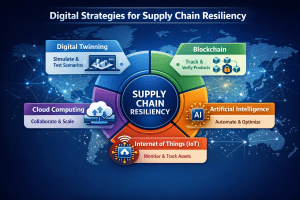
1. Digital Twinning – Simulate & Test Scenarios
Overview:
Digital twinning creates a virtual replica of a physical supply chain, allowing companies to simulate various scenarios and test responses without disrupting actual operations.
Applications:
- Simulate the impact of a supplier failure or transportation delay.
- Test different inventory strategies to see which minimizes disruptions.
- Assess the effect of natural disasters, strikes, or geopolitical events on delivery timelines.
Benefits:
- Identifies weak points in the supply chain before they become real problems.
- Enables contingency planning and faster decision-making.
- Reduces costs by preventing trial-and-error in real operations.
Example:
A UK-based electronics company can use digital twins to simulate how a port closure would affect shipments, allowing it to pre-plan alternative routes or suppliers.
2. Blockchain – Track & Verify Products to ensure supply chain resiliency
Overview:
Blockchain is a secure, decentralised ledger that records transactions across multiple participants, ensuring transparency and traceability.
Applications:
- Track the movement of goods from supplier to customer.
- Verify the authenticity of products and prevent counterfeiting.
- Facilitate faster payments and contracts through smart contracts.
Benefits:
- Improves trust among partners by providing an immutable record.
- Enhances regulatory compliance and reporting.
- Reduces losses due to fraud, theft, or mismanagement.
Example:
A pharmaceutical company can use blockchain to trace medicine from manufacturing to pharmacy shelves, preventing counterfeit drugs from entering the market.
3. Artificial Intelligence (AI) – Automate & Optimise to ensure supply chain resiliency
Overview:
AI uses advanced algorithms and machine learning to analyse large datasets, enabling predictive insights and automated decision-making in supply chain operations.
Applications:
- Predict demand fluctuations based on historical and real-time data.
- Optimise inventory levels and reduce overstock or stockouts.
- Automate logistics planning, including route optimization and load management.
Benefits:
- Faster response to changing market conditions.
- Reduces human error and operational costs.
- Enhances supply chain efficiency and customer satisfaction.
Example:
An e-commerce retailer in the UK can use AI to predict peak order periods and adjust inventory and shipping schedules accordingly, avoiding delays.
4. Internet of Things (IoT) – Monitor & Track Assets
Overview:
IoT connects physical devices to the internet, enabling real-time monitoring and communication across the supply chain.
Applications:
- Track shipment location and condition (temperature, humidity, vibration).
- Monitor equipment health to predict maintenance needs.
- Enable automated alerts for potential disruptions.
Benefits:
- Reduces losses due to spoilage or damage.
- Provides transparency for stakeholders.
- Improves operational efficiency with real-time insights.
Example:
A food distribution company can use IoT sensors to ensure perishable goods maintain the correct temperature throughout transit, preventing spoilage.
5. Cloud Computing – Collaborate & Scale
Overview:
Cloud computing provides scalable data storage and applications accessible over the internet, enabling better collaboration across supply chain partners.
Applications:
- Centralised access to inventory, shipment, and supplier data.
- Real-time collaboration with global suppliers and partners.
- Rapid scaling of systems during peak demand periods.
Benefits:
- Improves agility and responsiveness.
- Reduces IT infrastructure costs.
- Facilitates seamless communication and coordination.
Example:
A manufacturing firm can use cloud platforms to share production schedules with suppliers worldwide, ensuring timely delivery of raw materials and reducing bottlenecks.
Finally
The COVID-19 pandemic has demonstrated the need for businesses to be agile and resilient in the face of unexpected disruptions. To increase their supply chain resiliency, businesses must implement digitalized strategies such as digital twinning, blockchain, AI,  IoT, and cloud computing. These digitised strategies can help businesses identify potential weaknesses in the supply chain, automate and optimise various aspects of the supply chain, ensure transparency and accountability, and enable real-time collaboration with suppliers and partners.
By implementing these strategies, businesses can increase their supply chain resiliency and mitigate the impact of unexpected disruptions. However, businesses must also be mindful of potential drawbacks, such as data privacy concerns and the need for significant investments in technology and infrastructure.
Overall, the digitisation of supply chain management is a necessary step for businesses to remain competitive and thrive in today’s rapidly changing business landscape.
Supply chain resiliency is the ability of a supply chain to withstand and recover quickly from disruptions. These digitised strategies can help businesses identify potential weaknesses in the supply chain, automate and optimise various aspects of the supply chain, ensure transparency and accountability, and enable real-time collaboration with suppliers and partners. Yes, these strategies can be implemented in any industry that relies on a supply chain. A company can measure the effectiveness of these digitised strategies by monitoring key performance indicators (KPIs) such as lead time, inventory turnover, and customer satisfaction. Yes, potential drawbacks include data privacy concerns and the need for significant investments in technology and infrastructure. Digital Strategies

Alan is the Founder and MD at the Fresh Group of companies. You are welcome to use any information you find interesting. Please give us a link back to our webpage or post. It really helps SME’s rank in the UK.