
Comprehensive Guide to Warehouse Equipment for Optimised Operations
Efficient warehouse management is critical for streamlined operations, and the foundation of this efficiency is rooted in the right warehouse equipment. 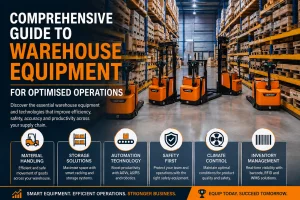 Every piece of equipment in a warehouse serves a vital role in material handling, storage, and inventory management. In this guide, we will explore the essential warehouse equipment that every facility needs to improve productivity, safety, and overall operational success.
First a quick plug – Our sister companies Fresh Pharma whom are GDP Compliant Pharma couriers and ‘Fresh Fridge Hire‘ are out (compliant GDP) refrigerated vehicle hire.
Key Takeaways
- Invest in Essential Equipment: Effective material handling and storage systems, such as forklifts, conveyor systems, and pallet racking, are fundamental to warehouse productivity and safety.
- Enhance Safety and Automation: Implementing safety equipment and automated systems like AGVs and AS/RS can significantly reduce accidents and boost operational efficiency.
- Use Technology for Efficiency: Inventory management systems such as WMS, RFID, and barcode scanning streamline operations, ensuring real-time tracking and minimising errors.
1. Warehouse Equipment – Material Handling Equipment (MHE)
Material handling equipment plays a pivotal role in moving goods through various stages in the warehouse. It is used for loading, unloading, and transporting materials across the warehouse.
1.1 Forklifts
Forklifts are indispensable for lifting and transporting heavy pallets across the warehouse. These powerful machines come in several varieties:
| Forklift Type | Features | Usage |
| Counterbalance Forklifts | Balances weight with a counterweight at the rear | Lifting heavy loads over short distances |
| Reach Trucks | Narrow design, extends reach into high racking | High rack operations, narrow aisle manoeuvring |
| Order Pickers | Elevates operator and load together | Efficient for picking individual items from racks |
| Pallet Jacks | Manual or electric operation, compact and simple | Moving pallets in tight or confined spaces |
1.2 Conveyor Systems
Conveyor systems automate the process of moving materials across different areas of the warehouse. There are several types of conveyor systems, each suited to specific tasks:
| Conveyor Type | Features | Ideal Use |
| Gravity Conveyor | Utilises gravity, no motor | Lightweight items or boxes moving downward |
| Powered Conveyor | Motorised movement | Larger, heavier products needing constant flow |
| Belt Conveyor | Belt-driven, continuous movement | Moving smaller or boxed products in packing areas |
| Roller Conveyor | Utilises rollers, flexible | Heavy materials like crates or pallets |
2. Warehouse Equipment – Storage Systems
Effective storage solutions are crucial for maintaining order and maximising the use of available warehouse space. These systems ensure easy access to inventory while optimising storage density.
2.1 Pallet Racking
Pallet racking is a warehouse staple that supports efficient stacking and access to goods. Common types include:
| Pallet Racking Type | Features | Best Application |
| Selective Racking | Single-depth, direct access to each pallet | General purpose storage, high selectivity |
| Drive-In Racking | Forklift access within racking system | High-density storage for bulk items |
| Push-Back Racking | Gravity-assisted, dynamic storage | First-in, last-out (FILO) inventory management |
| Cantilever Racking | Extended arms for long goods | Ideal for long items like pipes, lumber, or steel beams |
2.2 Shelving Systems
For smaller goods, shelving systems offer a flexible solution. Types of shelving systems include:
| Shelving System Type | Features | Ideal for |
| Wire Shelving | Open structure, lightweight | Items requiring airflow or quick access |
| Mobile Shelving | Movable, space-saving design | Small parts, maximising floor space |
| Bin Shelving | Compartmentalised bins | Organising small parts and components |
3. Lifting and Access Warehouse Equipment
Lifting and access equipment ensures safety and efficiency when handling goods stored at height. These tools are crucial for maintaining a productive and safe working environment.
3.1 Scissor Lifts
Scissor lifts offer a stable platform for workers to access high shelves and racks, making them ideal for inventory checks, maintenance, and repairs.
3.2 Aerial Lifts
Aerial lifts provide vertical and horizontal reach, which is useful for hard-to-access areas in the warehouse. These machines include boom lifts and vertical mast lifts, helping operators access confined spaces safely.
3.3 Ladder Systems
For smaller warehouses, well-constructed ladders can provide the necessary height access without the cost of heavy machinery. Rolling ladders with safety railings are ideal for accessing moderately high storage.
4. Warehouse Equipment – Safety
Ensuring safety in a warehouse environment is non-negotiable. Implementing the right safety equipment can drastically reduce the likelihood of accidents and injuries.
| Safety Equipment | Purpose | Application |
| Guardrails and Barriers | Prevent accidents in high-traffic areas | Installed near loading docks, conveyor belts, machines |
| Safety Netting and Backing | Prevents goods from falling off racks | Racks holding large or loose items |
| Personal Protective Equipment (PPE) | Protection for workers | Hard hats, steel-toe boots, goggles, and hi-vis vests |
5. Warehouse Equipment – Automated Warehouse Systems
Automation is reshaping the future of warehousing. Automated systems can significantly increase efficiency, reduce labour costs, and improve accuracy.
5.1 Automated Guided Vehicles (AGVs) in Warehouse Equipment
AGVs are mobile robots that navigate autonomously to transport materials across the warehouse. They reduce the need for manual labour and can efficiently move heavy loads.
5.2 Automated Storage and Retrieval Systems (AS/RS)
These systems automate the retrieval and storage of inventory. AS/RS uses high-speed cranes or shuttles to move items, improving accuracy and speeding up order fulfilment.
5.3 Robotics in Picking
Robotic arms and collaborative robots (cobots) are increasingly used in picking and packing processes, enhancing the speed and precision of operations.
6. Warehouse Equipment – Climate Control Systems: Essential for Temperature-Sensitive Goods
Maintaining optimal temperature and humidity levels in warehouses is critical for preserving the quality and safety of stored goods, particularly in sectors such as food, pharmaceuticals, and other temperature-sensitive industries. In such environments, fluctuations in temperature and humidity can have a significant impact on the integrity of products, making effective climate control systems a vital part of warehouse operations. Whether you are dealing with refrigerated, heated, or frozen warehouses, investing in the right climate control equipment ensures that your inventory is kept under the right conditions.
Industrial Fans
Industrial fans are essential in warehouse climate control systems as they improve air circulation and reduce overheating. They are widely used to regulate general temperature control across the facility, ensuring even distribution of air and preventing hot spots. Proper air circulation is especially important in large warehouses where hot spots can form. Fans also help to reduce the accumulation of dust, which can affect both products and the efficiency of machinery. These fans are commonly used in heated and ambient storage environments, where maintaining a steady airflow is important for worker comfort and product safety.
HVAC Systems
Heating, Ventilation, and Air Conditioning (HVAC) systems are vital for controlling temperature and humidity levels within a warehouse. These systems are particularly important in refrigerated and heated warehouses, where maintaining a stable environment is critical to prevent spoilage or degradation of products.
In refrigerated warehouses, HVAC systems ensure the temperature remains low enough to store perishable goods, such as dairy, meat, and pharmaceuticals, without freezing them. Frozen warehouses require HVAC systems designed specifically for sub-zero temperatures, keeping products at ideal freezing conditions. Heated warehouses, on the other hand, rely on HVAC systems to keep temperatures above a certain threshold, preventing cold damage to items like electronics, chemicals, and machinery.
Dehumidifiers
Dehumidifiers are a critical part of Warehouse Equipment in managing moisture and preventing dampness in warehouses, especially where temperature variations occur, such as in refrigerated or frozen environments. Excess moisture can lead to product damage, mould growth, and even equipment malfunction. In frozen warehouses, dehumidifiers prevent ice build-up, which can affect the quality of goods and the efficiency of operations.
In heated and ambient warehouses, dehumidifiers prevent excess humidity from damaging products or packaging materials. This helps extend the shelf life of products and ensures that they are kept in optimal conditions for both storage and distribution.
Climate Control System Overview
| System Type | Function | Application |
| Industrial Fans | Improve air circulation, reduce overheating | Heated and ambient storage environments |
| HVAC Systems | Control temperature and humidity levels | Refrigerated, frozen, and heated warehouses |
| Dehumidifiers | Manage moisture, prevent dampness | All warehouse types, especially refrigerated and frozen |
Finally.
Warehouse Equipment climate control systems are indispensable for maintaining the quality and safety of stored products, especially in refrigerated, heated, and frozen warehouses. Industrial fans ensure proper air circulation, reducing hot spots and improving air quality. HVAC systems provide the necessary control over temperature and humidity, making them essential in cold storage, heated, and freezing environments. Dehumidifiers help manage moisture levels, preventing damage from condensation and ensuring that products remain safe and intact. By investing in the right climate control solutions, warehouse operators can ensure optimal storage conditions, protecting their inventory and maximizing operational efficiency.
7. Warehouse Equipment – Inventory Management Systems (IMS)
Inventory management systems (IMS) are a key component of Warehouse Equipment and help in tracking and managing stock levels, ensuring efficient product flow and minimising errors.
7.1 Barcode Systems
Barcode systems are essential for real-time tracking and updating of stock levels. Workers scan goods as they enter and leave the warehouse, which updates the inventory records instantly.
7.2 Radio Frequency Identification (RFID)
RFID tags offer enhanced tracking capabilities compared to traditional barcodes. They provide real-time location tracking of inventory and do not require direct line-of-sight scanning.
7.3 Warehouse Management Systems (WMS)
WMS software integrates all inventory management tools into one platform, allowing warehouse managers to track stock, manage orders, and ensure smooth operations.
Conclusion to Warehouse Equipment
In today’s fast-paced and highly competitive marketplace, efficient warehouse operations are key to success. The right combination of material handling equipment, storage systems, and automation. This can significantly enhance the speed, accuracy, and safety of your warehouse processes. Forklifts, conveyor systems, and pallet racking provide the foundation for smooth material movement and organised storage. While specialised equipment like scissor lifts and aerial platforms ensure safe access to high shelves and hard-to-reach areas.
Safety is non-negotiable in any warehouse, and the implementation of guardrails, safety netting, and proper PPE. Will greatly reduces the risk of accidents. Automating processes with systems such as (AGVs) and AS/RS not only boosts efficiency but also cuts down on labour costs and human error. Robotics and automated inventory systems further improve picking accuracy. Thus enhancing productivity, especially in large-scale or e-commerce warehouses.
Climate control solutions like industrial fans, HVAC systems, and dehumidifiers ensure that environmental conditions are optimal for preserving product quality. While advanced inventory management systems (IMS) such as barcode scanning, RFID, and warehouse management software keep stock levels accurate. They keep them trackable in real-time.
In conclusion, outfitting your warehouse with the right mix of equipment and systems is not just about meeting today’s operational demands. It’s about future-proofing your facility to remain competitive. Investing in safety, automation, and inventory management will lead to better productivity. Therefore fewer errors, and a safer work environment, ultimately driving profitability and growth. A well-equipped and well-managed warehouse forms the backbone of any successful supply chain. Ensuring that goods flow efficiently from suppliers to customers.

Alan is the Founder and MD at the Fresh Group of companies. You are welcome to use any information you find interesting. Please give us a link back to our webpage or post. It really helps SME’s rank in the UK.