
Chilled Pharmaceutical Courier: Safe, Compliant Temperature-Controlled Delivery Across the UK
What Is a Chilled Pharmaceutical Courier?
A chilled pharmaceutical courier specialises in transporting temperature-sensitive medicines under tightly controlled conditions. Every 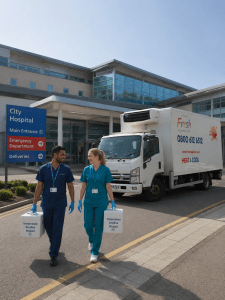 journey protects product integrity from collection through to final delivery. Unlike general parcel carriers, pharmaceutical couriers operate under strict procedures designed for healthcare products. Vehicles contain validated refrigeration systems that maintain precise temperatures throughout transit. Most chilled medicines require storage between +2°C and +8°C, although some products need different controlled ranges.
Drivers receive specialist training in pharmaceutical handling, temperature awareness, and Good Distribution Practice (GDP). Every movement follows documented procedures to minimise risk and maintain full traceability.
First a quick plug – Our sister companies Fresh Pharma whom are GDP Compliant Pharma couriers and ‘Fresh Fridge Hire‘ are our (compliant GDP) refrigerated vehicle hire.
A professional chilled pharmaceutical courier supports manufacturers, wholesalers, pharmacies, hospitals, research facilities, and clinical trial organisations. These deliveries often involve high-value medicines that cannot tolerate temperature fluctuations. Even brief exposure outside approved limits may reduce effectiveness or render products unusable.
| Feature | Why It Matters |
| +2°C to +8°C storage | Preserves medicine stability |
| Validated refrigeration | Maintains consistent temperatures |
| GDP-trained drivers | Ensures compliant handling |
| Temperature monitoring | Detects deviations immediately |
| Secure vehicles | Protects valuable pharmaceutical products |
| Proof of delivery | Creates a complete audit trail |
| UK-wide coverage | Supports nationwide healthcare supply chains |
For example, a hospital requiring urgent oncology medication expects products to arrive within the validated temperature range. Continuous monitoring provides reassurance that every medicine remains safe for patient use. Choosing a specialist chilled pharmaceutical courier reduces risk, supports regulatory compliance, and protects patient outcomes throughout the delivery process.
Why Temperature Control Is Critical for Medicines with a Chilled Pharmaceutical Courier
Temperature control remains one of the most important elements of pharmaceutical distribution. Many medicines contain delicate biological ingredients that deteriorate when exposed to excessive heat or freezing conditions. A reliable chilled pharmaceutical courier maintains stable temperatures throughout every stage of transport. This protects medicine quality and ensures patients receive products exactly as intended by the manufacturer.
Small temperature variations can cause irreversible damage. Vaccines may lose potency, biologic medicines can become unstable, and insulin effectiveness may decline. Damage often remains invisible, making continuous monitoring essential. Once a product falls outside its approved storage conditions, it may require quarantine or destruction.
Temperature-controlled transport also protects healthcare providers from unnecessary costs. Replacing compromised medicines increases expenditure and may delay patient treatment. Pharmaceutical manufacturers depend upon compliant couriers to minimise these risks.
| Risk | Potential Impact |
| Excessive heat | Reduced medicine effectiveness |
| Freezing | Permanent product damage |
| Temperature fluctuations | Product instability |
| Poor handling | Compliance failures |
| Missing records | Failed regulatory audits |
| Delivery delays | Interrupted patient care |
Imagine transporting a batch of flu vaccines during a summer heatwave. Without validated refrigeration, temperatures inside a standard van may exceed safe limits within minutes. A specialist chilled pharmaceutical courier prevents this scenario through insulated vehicles, calibrated refrigeration equipment, and continuous temperature recording.
Maintaining the correct environment protects medicine efficacy, safeguards patient health, and ensures full compliance with pharmaceutical regulations across the United Kingdom.
Which Pharmaceutical Products Require a Chilled Pharmaceutical Courier?
Many pharmaceutical products depend upon strict temperature control throughout storage and transport. A specialist chilled pharmaceutical courier ensures these sensitive products remain within validated temperature ranges from collection to delivery. Every shipment requires careful planning, secure handling, and continuous monitoring.
Vaccines represent one of the most common chilled pharmaceutical products. They lose effectiveness when exposed to unsuitable temperatures. Insulin also requires controlled transport to maintain stability for patients managing diabetes. Modern biologic medicines, including monoclonal antibodies, contain complex proteins that become unstable if temperature limits are exceeded.
Clinical trial materials require exceptional care because replacement stock may not exist. Delays or temperature excursions can affect research outcomes and patient recruitment. Blood products, plasma, and certain laboratory samples also demand strict temperature management to preserve quality.
| Pharmaceutical Product | Typical Temperature |
| Vaccines | +2°C to +8°C |
| Insulin | +2°C to +8°C |
| Biologics | Usually +2°C to +8°C |
| Clinical trial medicines | Product specific |
| Blood products | Controlled according to product |
| Diagnostic samples | Validated temperature range |
| Hospital medicines | Manufacturer guidance |
For example, a clinical trial may involve delivering investigational medicines to hospitals across Britain. Every shipment requires documented temperature records, secure chain of custody, and timed delivery windows. A professional chilled pharmaceutical courier ensures valuable medicines arrive safely while maintaining regulatory compliance and protecting the integrity of important healthcare treatments.
UK GDP Compliance for Chilled Pharmaceutical Courier Services
Good Distribution Practice (GDP) provides the regulatory framework for transporting medicinal products safely throughout the supply chain. Every chilled pharmaceutical courier operating within the United Kingdom should follow GDP principles to maintain medicine quality from collection to delivery.
Compliance demonstrates that products have remained within validated conditions and have been handled by trained personnel. The Medicines and Healthcare products Regulatory Agency (MHRA) expects pharmaceutical transport providers to maintain robust quality systems, documented procedures, and continuous staff training. Vehicles should be validated, refrigeration equipment calibrated, and temperature monitoring devices regularly checked.
Documentation plays a vital role because every movement must be traceable. Delivery records, temperature logs, maintenance reports, and driver training certificates may all form part of an audit. Pharmaceutical companies frequently audit their logistics partners before awarding contracts. Successful audits demonstrate reliability, regulatory compliance, and a commitment to patient safety. Failure to comply could result in rejected deliveries, damaged reputations, or regulatory action.
| GDP Compliance Requirement | Why It Matters |
| Validated refrigerated vehicles | Maintains approved storage temperatures |
| GDP-trained drivers | Ensures compliant product handling |
| Standard operating procedures | Provides consistent working practices |
| Equipment calibration | Confirms monitoring accuracy |
| Temperature records | Demonstrates continuous compliance |
| Delivery documentation | Creates a complete audit trail |
| Internal quality audits | Identifies opportunities for improvement |
| Corrective action procedures | Resolves compliance issues quickly |
For example, a pharmaceutical manufacturer delivering medicines to NHS hospitals requires evidence that every shipment remained within specification. A professional chilled pharmaceutical courier provides complete documentation, supporting both MHRA expectations and customer quality requirements.
How Chilled Pharmaceutical Courier Deliveries Are Monitored
Every chilled pharmaceutical courier relies on advanced monitoring technology to ensure medicines remain within their validated temperature range throughout transport. Continuous visibility reduces risk and provides confidence for pharmaceutical manufacturers, hospitals, pharmacies, and healthcare providers.
Modern refrigerated vehicles contain calibrated digital temperature sensors that record conditions throughout the journey. These systems generate accurate data without relying upon manual checks. Real-time temperature monitoring allows transport teams to identify any deviation immediately. If temperatures begin to move outside approved limits, corrective action can be taken before product quality becomes compromised. GPS vehicle tracking provides live location updates and estimated arrival times. Customers benefit from improved communication, while transport planners can respond quickly to traffic delays or unexpected incidents.
Digital temperature records replace traditional paper logs and simplify compliance reporting. Information can be securely stored for future audits and customer verification. Chain of custody procedures document every transfer between authorised personnel, ensuring accountability from collection through to final delivery.
| Monitoring System | Customer Benefit |
| Real-time temperature monitoring | Immediate alerts for temperature deviations |
| GPS vehicle tracking | Live delivery progress and accurate arrival times |
| Digital temperature records | Reliable compliance evidence |
| Electronic proof of delivery | Faster confirmation of receipt |
| Chain of custody records | Full shipment accountability |
| Vehicle telematics | Improved operational efficiency |
| Remote refrigeration monitoring | Rapid response to equipment issues |
| Secure cloud reporting | Easy access to historical delivery data |
For example, a hospital awaiting urgently needed biologic medicines can receive live delivery updates while viewing verified temperature records after completion. This transparency strengthens compliance, protects valuable pharmaceutical products, and reinforces confidence in the chilled pharmaceutical courier service.
The Importance of Validated Refrigerated Vehicles for a Chilled Pharmaceutical Courier
Validated refrigerated vehicles form the backbone of every professional chilled pharmaceutical courier service. Unlike standard refrigerated vans, validated vehicles undergo rigorous testing to prove they consistently maintain the required temperature range under real operating conditions.
Validation gives pharmaceutical manufacturers, hospitals, pharmacies, and laboratories confidence that medicines remain protected throughout every journey. Vehicle qualification assesses the refrigeration system, insulation, airflow, and temperature stability before the vehicle enters service. Temperature mapping is then completed using calibrated data loggers positioned throughout the load area.
This process identifies any hot or cold spots and confirms the vehicle maintains uniform temperatures in different weather conditions. Regular maintenance keeps refrigeration equipment operating efficiently and reduces the risk of unexpected breakdowns. Calibration ensures temperature sensors and monitoring devices continue to provide accurate readings.
Without scheduled servicing and calibration, recorded temperatures may become unreliable, creating unnecessary compliance risks. Professional operators also retain detailed maintenance records to demonstrate compliance during customer and regulatory audits. Investing in validated refrigerated vehicles protects valuable pharmaceutical products while supporting consistent service quality across the United Kingdom.
| Validation Element | Purpose |
| Vehicle qualification | Confirms suitability for pharmaceutical transport |
| Temperature mapping | Verifies consistent temperatures throughout the load space |
| Refrigeration maintenance | Reduces equipment failures |
| Sensor calibration | Ensures accurate temperature readings |
| Preventative servicing | Improves vehicle reliability |
| Validation reports | Provides evidence during audits |
| Insulated bodywork | Maintains stable internal conditions |
| Performance testing | Confirms operation in varying weather conditions |
For example, a courier transporting insulin during a winter morning and a summer afternoon must maintain identical storage conditions. A validated chilled pharmaceutical courier achieves this through tested equipment, scheduled maintenance, and documented temperature performance.
Risks of Poor Temperature-Controlled Transport with a Chilled Pharmaceutical Courier
Poor temperature-controlled transport creates significant risks throughout the pharmaceutical supply chain. A reputable chilled pharmaceutical courier reduces these risks by maintaining validated temperatures and following strict handling procedures. Medicines exposed to unsuitable temperatures may suffer irreversible degradation, even when packaging appears undamaged. Vaccines, biologics, insulin, and specialist medicines are particularly vulnerable to temperature excursions.
Once product integrity is questioned, pharmaceutical companies often quarantine or destroy the affected stock. This results in avoidable financial losses and unnecessary waste. Regulatory breaches can also occur when temperature records are incomplete or delivery procedures fail to meet Good Distribution Practice standards.
These issues may trigger customer audits, compliance investigations, and reputational damage. Most importantly, compromised medicines could place patient health at risk if effectiveness has been reduced. Every stage of transport should therefore focus on maintaining validated conditions and complete traceability. Professional pharmaceutical couriers invest heavily in equipment, training, and monitoring because prevention remains far less costly than product replacement or regulatory action.
| Risk | Possible Consequence |
| Product degradation | Reduced medicine effectiveness |
| Temperature excursions | Product quarantine or disposal |
| Delivery delays | Interrupted patient treatment |
| Missing documentation | Failed compliance audits |
| Equipment failure | Loss of temperature control |
| Regulatory breaches | MHRA compliance concerns |
| Financial losses | Replacement stock and operational costs |
| Patient harm | Reduced treatment effectiveness |
For example, if vaccines become too warm during transport, they may require disposal despite appearing unchanged. A specialist chilled pharmaceutical courier prevents these costly situations through validated vehicles, continuous monitoring, and documented compliance.
Same-Day Chilled Pharmaceutical Courier Services Across the UK
Same-day chilled pharmaceutical courier services provide rapid, secure transport for temperature-sensitive medicines when time is critical. Healthcare providers often require urgent deliveries that cannot wait for overnight distribution. Specialist couriers operate dedicated refrigerated vehicles capable of collecting and delivering consignments directly without unnecessary handling or delays. Emergency deliveries support hospitals facing unexpected medicine shortages or urgent patient treatment requirements.
Pharmacy transfers enable stock to move quickly between locations, helping maintain medicine availability and reduce waste. Hospitals also rely on same-day collections for laboratory samples, specialist medicines, and urgent medical supplies. Dedicated transport reduces transit times because the vehicle carries only the customer’s consignment. Continuous temperature monitoring, GPS tracking, and electronic proof of delivery provide complete visibility throughout the journey.
Professional drivers understand the importance of urgency while maintaining full GDP compliance. Every delivery follows documented procedures that protect product integrity and maintain an uninterrupted chain of custody from collection to final handover.
| Same-Day Service | Typical Use |
| Emergency medicine delivery | Urgent patient treatment |
| Hospital collections | Time-sensitive pharmaceutical transport |
| Pharmacy transfers | Rapid stock redistribution |
| Clinical trial deliveries | Scheduled research requirements |
| Laboratory sample transport | Fast diagnostic testing |
| Direct dedicated vehicle | No unnecessary handling |
| Nationwide same-day service | UK-wide pharmaceutical support |
| Electronic proof of delivery | Immediate delivery confirmation |
For example, a hospital experiencing an unexpected shortage of oncology medicines may require replacement stock within hours. A dedicated chilled pharmaceutical courier collects the medicines immediately, maintains the required temperature throughout transit, and delivers them directly to the hospital, supporting patient care without compromising product quality.
The Importance of Validated Refrigerated Vehicles for a Chilled Pharmaceutical Courier
Validated refrigerated vehicles form the backbone of every professional chilled pharmaceutical courier service. Unlike standard refrigerated vans, validated vehicles undergo rigorous testing to prove they consistently maintain the required temperature range under real operating conditions.
Validation gives pharmaceutical manufacturers, hospitals, pharmacies, and laboratories confidence that medicines remain protected throughout every journey. Vehicle qualification assesses the refrigeration system, insulation, airflow, and temperature stability before the vehicle enters service. Temperature mapping is then completed using calibrated data loggers positioned throughout the load area. This process identifies any hot or cold spots and confirms the vehicle maintains uniform temperatures in different weather conditions. Regular maintenance keeps refrigeration equipment operating efficiently and reduces the risk of unexpected breakdowns.
Calibration ensures temperature sensors and monitoring devices continue to provide accurate readings. Without scheduled servicing and calibration, recorded temperatures may become unreliable, creating unnecessary compliance risks. Professional operators also retain detailed maintenance records to demonstrate compliance during customer and regulatory audits. Investing in validated refrigerated vehicles protects valuable pharmaceutical products while supporting consistent service quality across the United Kingdom.
| Validation Element | Purpose |
| Vehicle qualification | Confirms suitability for pharmaceutical transport |
| Temperature mapping | Verifies consistent temperatures throughout the load space |
| Refrigeration maintenance | Reduces equipment failures |
| Sensor calibration | Ensures accurate temperature readings |
| Preventative servicing | Improves vehicle reliability |
| Validation reports | Provides evidence during audits |
| Insulated bodywork | Maintains stable internal conditions |
| Performance testing | Confirms operation in varying weather conditions |
For example, a courier transporting insulin during a winter morning and a summer afternoon must maintain identical storage conditions. A validated chilled pharmaceutical courier achieves this through tested equipment, scheduled maintenance, and documented temperature performance.
Risks of Poor Temperature-Controlled Transport with a Chilled Pharmaceutical Courier
Poor temperature-controlled transport creates significant risks throughout the pharmaceutical supply chain. A reputable chilled pharmaceutical courier reduces these risks by maintaining validated temperatures and following strict handling procedures. Medicines exposed to unsuitable temperatures may suffer irreversible degradation, even when packaging appears undamaged. Vaccines, biologics, insulin, and specialist medicines are particularly vulnerable to temperature excursions. Once product integrity is questioned, pharmaceutical companies often quarantine or destroy the affected stock.
This results in avoidable financial losses and unnecessary waste. Regulatory breaches can also occur when temperature records are incomplete or delivery procedures fail to meet Good Distribution Practice standards. These issues may trigger customer audits, compliance investigations, and reputational damage.
Most importantly, compromised medicines could place patient health at risk if effectiveness has been reduced. Every stage of transport should therefore focus on maintaining validated conditions and complete traceability. Professional pharmaceutical couriers invest heavily in equipment, training, and monitoring because prevention remains far less costly than product replacement or regulatory action.
| Risk | Possible Consequence |
| Product degradation | Reduced medicine effectiveness |
| Temperature excursions | Product quarantine or disposal |
| Delivery delays | Interrupted patient treatment |
| Missing documentation | Failed compliance audits |
| Equipment failure | Loss of temperature control |
| Regulatory breaches | MHRA compliance concerns |
| Financial losses | Replacement stock and operational costs |
| Patient harm | Reduced treatment effectiveness |
For example, if vaccines become too warm during transport, they may require disposal despite appearing unchanged. A specialist chilled pharmaceutical courier prevents these costly situations through validated vehicles, continuous monitoring, and documented compliance.
Same-Day Chilled Pharmaceutical Courier Services Across the UK
Same-day chilled pharmaceutical courier services provide rapid, secure transport for temperature-sensitive medicines when time is critical. Healthcare providers often require urgent deliveries that cannot wait for overnight distribution. Specialist couriers operate dedicated refrigerated vehicles capable of collecting and delivering consignments directly without unnecessary handling or delays.
Emergency deliveries support hospitals facing unexpected medicine shortages or urgent patient treatment requirements. Pharmacy transfers enable stock to move quickly between locations, helping maintain medicine availability and reduce waste. Hospitals also rely on same-day collections for laboratory samples, specialist medicines, and urgent medical supplies.
Dedicated transport reduces transit times because the vehicle carries only the customer’s consignment. Continuous temperature monitoring, GPS tracking, and electronic proof of delivery provide complete visibility throughout the journey. Professional drivers understand the importance of urgency while maintaining full GDP compliance. Every delivery follows documented procedures that protect product integrity and maintain an uninterrupted chain of custody from collection to final handover.
| Same-Day Service | Typical Use |
| Emergency medicine delivery | Urgent patient treatment |
| Hospital collections | Time-sensitive pharmaceutical transport |
| Pharmacy transfers | Rapid stock redistribution |
| Clinical trial deliveries | Scheduled research requirements |
| Laboratory sample transport | Fast diagnostic testing |
| Direct dedicated vehicle | No unnecessary handling |
| Nationwide same-day service | UK-wide pharmaceutical support |
| Electronic proof of delivery | Immediate delivery confirmation |
For example, a hospital experiencing an unexpected shortage of oncology medicines may require replacement stock within hours. A dedicated chilled pharmaceutical courier collects the medicines immediately, maintains the required temperature throughout transit, and delivers them directly to the hospital, supporting patient care without compromising product quality.
The Importance of Validated Refrigerated Vehicles for a Chilled Pharmaceutical Courier
Validated refrigerated vehicles form the backbone of every professional chilled pharmaceutical courier service. Unlike standard refrigerated vans, validated vehicles undergo rigorous testing to prove they consistently maintain the required temperature range under real operating conditions. Validation gives pharmaceutical manufacturers, hospitals, pharmacies, and laboratories confidence that medicines remain protected throughout every journey.
Vehicle qualification assesses the refrigeration system, insulation, airflow, and temperature stability before the vehicle enters service. Temperature mapping is then completed using calibrated data loggers positioned throughout the load area. This process identifies any hot or cold spots and confirms the vehicle maintains uniform temperatures in different weather conditions. Regular maintenance keeps refrigeration equipment operating efficiently and reduces the risk of unexpected breakdowns. Calibration ensures temperature sensors and monitoring devices continue to provide accurate readings.
Without scheduled servicing and calibration, recorded temperatures may become unreliable, creating unnecessary compliance risks. Professional operators also retain detailed maintenance records to demonstrate compliance during customer and regulatory audits. Investing in validated refrigerated vehicles protects valuable pharmaceutical products while supporting consistent service quality across the United Kingdom.
| Validation Element | Purpose |
| Vehicle qualification | Confirms suitability for pharmaceutical transport |
| Temperature mapping | Verifies consistent temperatures throughout the load space |
| Refrigeration maintenance | Reduces equipment failures |
| Sensor calibration | Ensures accurate temperature readings |
| Preventative servicing | Improves vehicle reliability |
| Validation reports | Provides evidence during audits |
| Insulated bodywork | Maintains stable internal conditions |
| Performance testing | Confirms operation in varying weather conditions |
For example, a courier transporting insulin during a winter morning and a summer afternoon must maintain identical storage conditions. A validated chilled pharmaceutical courier achieves this through tested equipment, scheduled maintenance, and documented temperature performance.
Risks of Poor Temperature-Controlled Transport with a Chilled Pharmaceutical Courier
Poor temperature-controlled transport creates significant risks throughout the pharmaceutical supply chain. A reputable chilled pharmaceutical courier reduces these risks by maintaining validated temperatures and following strict handling procedures. Medicines exposed to unsuitable temperatures may suffer irreversible degradation, even when packaging appears undamaged. Vaccines, biologics, insulin, and specialist medicines are particularly vulnerable to temperature excursions.
Once product integrity is questioned, pharmaceutical companies often quarantine or destroy the affected stock. This results in avoidable financial losses and unnecessary waste. Regulatory breaches can also occur when temperature records are incomplete or delivery procedures fail to meet Good Distribution Practice standards. These issues may trigger customer audits, compliance investigations, and reputational damage.
Most importantly, compromised medicines could place patient health at risk if effectiveness has been reduced. Every stage of transport should therefore focus on maintaining validated conditions and complete traceability. Professional pharmaceutical couriers invest heavily in equipment, training, and monitoring because prevention remains far less costly than product replacement or regulatory action.
| Risk | Possible Consequence |
| Product degradation | Reduced medicine effectiveness |
| Temperature excursions | Product quarantine or disposal |
| Delivery delays | Interrupted patient treatment |
| Missing documentation | Failed compliance audits |
| Equipment failure | Loss of temperature control |
| Regulatory breaches | MHRA compliance concerns |
| Financial losses | Replacement stock and operational costs |
| Patient harm | Reduced treatment effectiveness |
For example, if vaccines become too warm during transport, they may require disposal despite appearing unchanged. A specialist chilled pharmaceutical courier prevents these costly situations through validated vehicles, continuous monitoring, and documented compliance.
Same-Day Chilled Pharmaceutical Courier Services Across the UK
Same-day chilled pharmaceutical courier services provide rapid, secure transport for temperature-sensitive medicines when time is critical. Healthcare providers often require urgent deliveries that cannot wait for overnight distribution. Specialist couriers operate dedicated refrigerated vehicles capable of collecting and delivering consignments directly without unnecessary handling or delays.
Emergency deliveries support hospitals facing unexpected medicine shortages or urgent patient treatment requirements. Pharmacy transfers enable stock to move quickly between locations, helping maintain medicine availability and reduce waste. Hospitals also rely on same-day collections for laboratory samples, specialist medicines, and urgent medical supplies. Dedicated transport reduces transit times because the vehicle carries only the customer’s consignment.
Continuous temperature monitoring, GPS tracking, and electronic proof of delivery provide complete visibility throughout the journey. Professional drivers understand the importance of urgency while maintaining full GDP compliance. Every delivery follows documented procedures that protect product integrity and maintain an uninterrupted chain of custody from collection to final handover.
| Same-Day Service | Typical Use |
| Emergency medicine delivery | Urgent patient treatment |
| Hospital collections | Time-sensitive pharmaceutical transport |
| Pharmacy transfers | Rapid stock redistribution |
| Clinical trial deliveries | Scheduled research requirements |
| Laboratory sample transport | Fast diagnostic testing |
| Direct dedicated vehicle | No unnecessary handling |
| Nationwide same-day service | UK-wide pharmaceutical support |
| Electronic proof of delivery | Immediate delivery confirmation |
For example, a hospital experiencing an unexpected shortage of oncology medicines may require replacement stock within hours. A dedicated chilled pharmaceutical courier collects the medicines immediately, maintains the required temperature throughout transit, and delivers them directly to the hospital, supporting patient care without compromising product quality.
Pharmaceutical Cold Chain Best Practices for a Chilled Pharmaceutical Courier
Maintaining an unbroken cold chain is essential for protecting temperature-sensitive medicines during transport. A professional chilled pharmaceutical courier follows established best practices to ensure pharmaceutical products remain within their validated temperature range from collection to final delivery.
Every stage of the journey must minimise the risk of temperature excursions. Secure packaging provides the first layer of protection by insulating products against external conditions. Pharmaceutical packaging often includes validated insulated containers, gel packs, or phase-change materials designed for specific transit times. Temperature stability depends upon maintaining a consistent environment throughout the journey. Frequent vehicle door openings allow warm air to enter the load space, increasing the risk of temperature fluctuations. Professional drivers plan deliveries carefully to reduce unnecessary access to refrigerated compartments.
Rapid delivery routes also play an important role. Intelligent route planning shortens transit times, reduces traffic delays, and limits exposure to external temperatures. Combined with continuous temperature monitoring and GDP-compliant handling procedures, these measures help preserve medicine quality and patient safety. Every successful delivery depends upon preparation, reliable equipment, and experienced personnel.
| Cold Chain Best Practice | Benefit |
| Secure insulated packaging | Protects products during transport |
| Stable refrigerated temperatures | Maintains medicine effectiveness |
| Minimal door openings | Reduces temperature fluctuations |
| Optimised delivery routes | Shortens journey times |
| Dedicated pharmaceutical vehicles | Prevents cross-contamination |
| Continuous temperature monitoring | Detects deviations immediately |
| GDP-compliant handling | Maintains regulatory compliance |
| Pre-cooled load compartments | Ensures correct loading conditions |
For example, transporting vaccines during a busy summer period requires careful planning. A specialist chilled pharmaceutical courier combines secure packaging, validated refrigeration, and efficient routing to ensure products arrive within specification.
Choosing the Right Chilled Pharmaceutical Courier
Selecting the right chilled pharmaceutical courier directly affects product quality, regulatory compliance, and patient safety.  Pharmaceutical logistics requires far more than refrigerated transport. It demands experienced personnel, validated equipment, and documented procedures that meet Good Distribution Practice requirements.
GDP-trained drivers understand how temperature-sensitive medicines should be handled throughout collection, transport, and delivery. They recognise the importance of maintaining the cold chain and following strict chain of custody procedures. A courier operating 24 hours a day, seven days a week can respond quickly to urgent healthcare requirements, including emergency hospital deliveries and time-critical pharmacy transfers.
Nationwide coverage ensures consistent service across England, Scotland, Wales, and Northern Ireland without relying upon multiple providers. Experience within healthcare logistics is equally important. Established pharmaceutical couriers understand customer expectations, regulatory requirements, and the importance of accurate documentation. Choosing an experienced provider reduces operational risks while improving delivery reliability and customer confidence.
| Selection Criteria | Why It Matters |
| GDP-trained drivers | Compliant pharmaceutical handling |
| 24/7 availability | Supports emergency deliveries |
| Nationwide coverage | Consistent UK-wide service |
| Healthcare logistics experience | Reduces operational risk |
| Validated refrigerated vehicles | Maintains temperature integrity |
| Live tracking | Provides shipment visibility |
| Electronic documentation | Simplifies compliance |
| Dedicated customer support | Fast response to urgent enquiries |
For example, a pharmaceutical wholesaler supplying multiple NHS hospitals benefits from one trusted chilled pharmaceutical courier offering nationwide coverage, trained staff, and around-the-clock availability.
Technology Used in Modern Chilled Pharmaceutical Courier Transport
Technology has transformed the way a chilled pharmaceutical courier manages temperature-sensitive deliveries. Modern systems improve visibility, strengthen compliance, and provide customers with greater confidence throughout the transport process. Live vehicle tracking enables customers to monitor delivery progress in real time.
Accurate estimated arrival times help hospitals, pharmacies, and laboratories prepare for incoming consignments. Electronic Proof of Delivery (ePOD) replaces paper documentation with secure digital records. Delivery signatures, timestamps, and location details are captured instantly, creating a reliable audit trail. Temperature alarms provide another critical safeguard. If refrigerated conditions move outside validated limits, automatic alerts allow transport teams to investigate immediately and take corrective action.
Remote fleet management enables operators to monitor refrigeration performance, vehicle location, maintenance schedules, and driver activity from a central control centre. These technologies improve operational efficiency while supporting GDP compliance and protecting valuable pharmaceutical products. Digital systems also reduce paperwork, improve reporting accuracy, and provide faster access to historical delivery information during customer audits.
| Technology | Customer Advantage |
| Live GPS tracking | Real-time shipment visibility |
| Electronic Proof of Delivery | Instant delivery confirmation |
| Temperature alarms | Immediate response to deviations |
| Remote fleet management | Continuous operational oversight |
| Digital temperature logging | Accurate compliance records |
| Vehicle telematics | Improved route efficiency |
| Cloud-based reporting | Easy access to delivery history |
| Automated notifications | Better customer communication |
For example, a hospital awaiting urgent oncology medicines can track the vehicle live, receive electronic delivery confirmation, and review verified temperature records immediately after the consignment arrives. This technology ensures transparency, strengthens compliance, and enhances trust in the chilled pharmaceutical courier service.
Industries That Depend on Chilled Pharmaceutical Couriers
A wide range of healthcare organisations rely on chilled pharmaceutical couriers to maintain the integrity of temperature-sensitive medicines and medical products throughout the supply chain. Reliable cold chain logistics ensure products arrive safely, compliantly and ready for use.
NHS Trusts
NHS Trusts depend on specialist chilled couriers to transport vaccines, medicines, blood products and laboratory samples between hospitals, pharmacies and healthcare facilities without compromising temperature control.
Private Hospitals
Private healthcare providers require secure, time-critical deliveries of pharmaceuticals, biologics and specialist medicines to support patient treatment and minimise disruption to clinical services.
Pharmaceutical Manufacturers
Manufacturers rely on GDP-compliant transport to move products from production facilities to wholesalers, hospitals, pharmacies and distribution centres while maintaining strict temperature requirements.
Clinical Research Organisations
Clinical trials often involve highly valuable, temperature-sensitive investigational medicinal products (IMPs). Specialist couriers ensure these products reach research sites with complete temperature records and full chain of custody.
Pharmaceutical Wholesalers
Wholesalers require dependable refrigerated transport to distribute medicines quickly and efficiently across the UK, ensuring pharmacies, hospitals and healthcare providers receive stock in perfect condition.
Frequently Asked Questions About Chilled Pharmaceutical Couriers
How cold should pharmaceutical deliveries be?
Most chilled medicines are transported between +2°C and +8°C, although some products have different temperature requirements specified by the manufacturer.
What happens if temperatures go out of range?
Any temperature excursion must be recorded, investigated and assessed to determine whether the product remains safe and effective for use.
Are refrigerated vehicles validated?
Yes. Professional pharmaceutical couriers use validated refrigerated vehicles that are temperature mapped, regularly calibrated and maintained in accordance with GDP requirements.
Can pharmaceuticals be delivered the same day?
Absolutely. Many specialist pharmaceutical couriers provide same-day and emergency delivery services for hospitals, pharmacies, laboratories and healthcare providers across the UK.
Future Trends in Pharmaceutical Cold Chain Logistics
Advances in technology continue to improve the safety, efficiency and transparency of pharmaceutical transport.
Connected Vehicles
Modern refrigerated vehicles are increasingly connected, allowing fleet managers to monitor vehicle location, temperature and performance in real time.
IoT Temperature Sensors
Internet of Things (IoT) sensors provide continuous temperature monitoring with instant alerts if conditions move outside acceptable limits.
Sustainable Refrigerated Transport
The industry is investing in lower-emission vehicles, improved refrigeration technology and more efficient route planning to reduce environmental impact.
Enhanced Compliance Reporting
Digital records, automated reporting and cloud-based documentation make it easier to demonstrate GDP compliance and prepare for regulatory audits.
Why Fresh Logistics Is a Trusted Chilled Pharmaceutical Courier
Fresh Logistics provides dependable temperature-controlled pharmaceutical transport throughout the UK, supporting healthcare providers with secure, compliant and time-critical deliveries.
Our GDP-compliant operations are designed to protect product integrity from collection through to delivery. Operating 24 hours a day, seven days a week, our nationwide network ensures urgent pharmaceutical consignments reach their destination quickly and safely.
Our modern temperature-controlled fleet is equipped with real-time GPS tracking, temperature monitoring and electronic Proof of Delivery (ePOD), providing complete visibility throughout every journey.
With experienced pharmaceutical logistics specialists, validated refrigerated vehicles and a commitment to exceptional service, Fresh Logistics is a trusted partner for pharmaceutical manufacturers, NHS Trusts, private hospitals, wholesalers and clinical research organisations requiring reliable chilled courier services across the UK.
Conclusion
Choosing the right chilled pharmaceutical courier is essential for protecting temperature-sensitive medicines, maintaining regulatory compliance and ensuring patient safety. From vaccines and biologics to clinical trial materials and blood products, every delivery must remain within strict temperature parameters throughout the journey.
A professional GDP-compliant courier provides more than simply transporting goods. They offer validated refrigerated vehicles, real-time temperature monitoring, complete chain of custody and experienced drivers who understand the importance of pharmaceutical cold chain logistics.
At Fresh Logistics, we deliver dependable chilled pharmaceutical courier services across the UK, operating 24/7 to support the NHS, private healthcare providers, pharmaceutical manufacturers and clinical research organisations. With our modern temperature-controlled fleet, nationwide coverage and commitment to quality, you can trust us to keep your pharmaceuticals protected every mile of the way.
Need a reliable chilled pharmaceutical courier? Contact Fresh Logistics today to discuss your temperature-controlled transport requirements and discover how our specialist logistics solutions can support your business.
Pharmaceutical Cold Chain
- What is a pharmaceutical cold chain?
The pharmaceutical cold chain refers to a temperature-controlled supply chain used to store, transport, and distribute medications that are sensitive to heat or temperature fluctuations. It ensures that these products remain effective, safe, and stable from the point of manufacture to the end user.
- What are the 2 types of cold chain?
The two main types of cold chain are:
- Refrigerated Cold Chain: Maintains temperatures typically between 2°C and 8°C (36°F to 46°F). This is the most common type used for vaccines and many biologics.
- Frozen Cold Chain: Maintains temperatures at or below -20°C (-4°F). This is required for some vaccines, certain drugs, and raw materials.
Some ultra-cold chains (e.g., -70°C) exist for highly sensitive products like some mRNA vaccines.
- What is the purpose of the cold chain?
The purpose of the cold chain is to:
- Maintain the integrity and effectiveness of temperature-sensitive medications
- Prevent spoilage, contamination, or degradation
- Ensure patient safety and treatment efficacy
- Comply with regulatory standards and good distribution practices
- What is the cold chain rule for medicine?
The cold chain rule requires that temperature-sensitive medicines must be consistently stored and transported within a specific temperature range (e.g., 2–8°C for refrigerated products) without interruption. Any break in the chain—called a cold chain breach—can compromise the quality, potency, and safety of the medicine.
- What are examples of cold chain drugs?
Examples of cold chain drugs include:
- Vaccines (e.g., Pfizer-BioNTech COVID-19 vaccine, flu vaccine)
- Insulin
- Biologics (e.g., monoclonal antibodies, growth hormones)
- Certain antibiotics
- Blood products and plasma-derived products

Alan is the Founder and MD at the Fresh Group of companies. You are welcome to use any information you find interesting. Please give us a link back to our webpage or post. It really helps SME’s rank in the UK.